Curaçao Screwworm Eradication Campaign
Silent SpringThe Curaçao Screwworm Eradication Campaign was a striking field demonstration that an insect pest could be eliminated without blanketing a landscape in poison: sterile screwworms were bred in a laboratory, flown to an isolated Caribbean island, and released from the air until reproduction collapsed. Within seven weeks, eggs laid on experimental goats were infertile; soon no egg masses could be found, and the screwworm had been eradicated on Curaçao. The success offered a consequential alternative to chemical control, while also setting up the far more difficult question of whether the method could work at a scale hundreds of times greater.
Background and Rationale
The campaign grew from years of research into the screwworm’s biology by United States Department of Agriculture scientists in Texas. The stakes were substantial: the pest had spread into southern Alabama and Georgia, and the livestock industry of the southeastern states faced annual losses estimated at $20 million. The accumulated biological knowledge made it possible to move beyond broad chemical treatment and test a method directed at the insect’s capacity to reproduce.
By 1954, after preliminary field trials on islands in Florida, Dr. Knipling was ready to test his theory on a larger scale. The choice of Curaçao, made by arrangement with the Dutch Government, was integral to the experiment rather than incidental: the island was separated from the mainland by at least 50 miles of sea. That isolation made it possible to test whether sustained releases of sterile insects could suppress a population without continual immigration undoing the result.
The Field Experiment
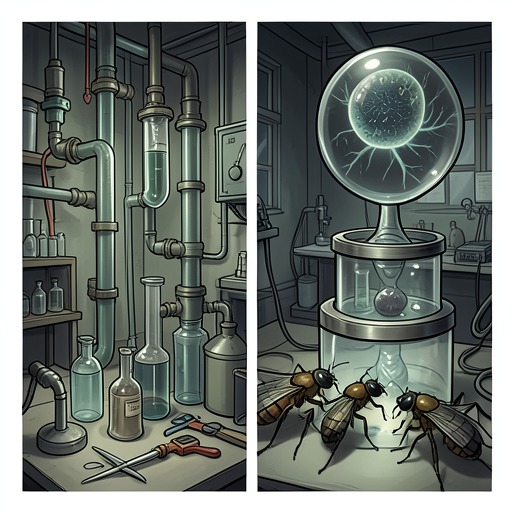
Beginning in August 1954, screwworms reared and sterilized in a Department of Agriculture laboratory in Florida were transported by air to Curaçao. Aircraft released them at a rate of about 400 per square mile each week. The approach did not attempt to poison the island or destroy every organism sharing the screwworm’s habitat. It introduced sterile members of the target species into the reproductive process, making control depend on the failure of eggs to produce offspring.
The experiment’s early indicators appeared on goats used for observation. Almost at once, the number of egg masses deposited on them began to fall, as did the fertility of the eggs. Seven weeks after releases began, all the eggs were infertile. Soon investigators could not find a single egg mass, whether sterile or otherwise. The sequence—from fewer egg masses, to complete infertility, to no detectable egg masses—gave the campaign a measurable endpoint rather than relying only on a general impression that the pest had diminished.
Eradication and Its Significance
The book describes the result without qualification: the screwworm had been eradicated on Curaçao. The rapid collapse of reproduction made the island trial a resounding success and showed that biological knowledge could be put to work in a practical control program. In the book’s broader argument about pesticide use, this mattered because it supplied an example of a different kind of intervention: instead of spreading a lethal chemical with effects extending beyond the intended pest, the campaign used sterile screwworms to interrupt that pest’s breeding.
The success immediately raised expectations beyond the island. Florida livestock raisers, seeking relief from the screwworm, were eager for a similar achievement. But the comparison also exposed a crucial limit to what the trial alone could prove: the Florida undertaking would cover an area 300 times larger than Curaçao, making the logistical and ecological challenge enormously greater. The island experiment established the method’s promise; it did not, by itself, establish that the same result could be reproduced across a vastly larger territory.